There’s a conversation I have at least once a week that goes something like this: an owner brings their herding dog in for its annual vaccination, I do the jab, and they head home. The whole visit takes ten minutes. No examination. No discussion. Just a needle and an invoice.
That’s not a wellness exam. That’s a vaccination appointment with a missed opportunity bolted on.
The annual checkup is the single most valuable thing you can do for your herding dog’s long-term health, and yet it’s consistently undervalued — by owners who see it as a formality and, honestly, by some vets who don’t allocate enough time to do it properly. I’ve caught cancers, heart murmurs, early kidney disease, and orthopaedic problems during routine wellness exams that would have gone undetected for months if we’d just done the jab and waved them off.
Let me walk you through what a proper annual exam should look like for a herding breed, because these dogs have specific vulnerabilities that a generic once-over will miss.
Why Herding Breeds Need More Than a Quick Look
Every dog benefits from an annual exam. But herding breeds warrant particular attention for several reasons.
First, they’re stoic. Border Collies, German Shepherds, Australian Shepherds — these dogs were bred to work through discomfort. A Labrador with a sore hip will limp and look pathetic. A working Collie with the same problem will run on it until the leg stops functioning entirely. I’ve examined Border Collies with cruciate injuries that their owners swore were “completely fine” because the dog was still fetching a ball. The dog wasn’t fine. It had simply decided that the ball was more important than the pain.
Second, they’re predisposed to conditions that develop gradually. Hip dysplasia, degenerative myelopathy, progressive retinal atrophy, cardiac disease — these don’t announce themselves with a dramatic crisis. They creep in. And the only way to catch them early is to look for them systematically, every year, before the owner notices something wrong.
Third, these are often active dogs with high physical demands. A working dog carrying an exercise injury can compensate remarkably well, masking problems that worsen over months. The annual exam is the safety net.
The Head-to-Tail Examination
Here’s what I actually check during a thorough wellness exam, and why each part matters for herding breeds specifically.
Eyes
I check pupil response, lens clarity, and retinal health. This is non-negotiable for herding breeds.
Collie Eye Anomaly affects Rough and Smooth Collies, Border Collies, and Shetland Sheepdogs. Progressive Retinal Atrophy is seen across multiple herding breeds. Cataracts develop in Australian Shepherds at higher rates than the general population. Early detection of any of these changes the management plan entirely.
For working dogs, I also assess for any trauma — grass seeds behind the third eyelid, corneal scratches from running through rough cover, early pannus (chronic superficial keratitis) in German Shepherds. Pannus is one I see missed too often. It starts as a subtle pigmentation of the cornea that’s easy to overlook if you’re not specifically looking for it. Left untreated, it progresses to vision impairment.
Ears
Herding breeds with erect ears (German Shepherds, some Collies) generally have fewer ear problems than floppy-eared breeds. But those with pendulous or semi-erect ears — Australian Shepherds, Bearded Collies — are prone to otitis, particularly if they’re already dealing with allergic skin disease.
I check for redness, discharge, odour, and pain on manipulation. Chronic ear disease in a herding breed almost always means an underlying allergy that needs addressing, not just another course of ear drops.
Mouth and Teeth
The state of your dog’s mouth tells me more than most owners expect. Dental disease in herding breeds is incredibly common and directly impacts systemic health — the bacteria from periodontal disease enter the bloodstream with every meal and every chew, seeding the heart valves, kidneys, and liver.
I’m looking for tartar buildup, gingivitis, fractured teeth (common in dogs that chew stones or catch hard objects), and oral masses. German Shepherds have a higher incidence of oral melanoma than many breeds, which makes the oral exam even more important.
For working farm dogs that I know are chewing on things they shouldn’t — hoof trimmings, bones, fence posts — I pay particular attention to the carnassial teeth, which are the big shearing teeth at the back. Slab fractures of these teeth are painfully common and surprisingly easy to miss because the dog doesn’t show obvious signs.
Heart and Lungs
I listen to the heart from both sides of the chest and at various points. What I’m feeling for is rhythm, rate, and any murmurs. Herding breeds can develop dilated cardiomyopathy, and in German Shepherds, aortic stenosis is a recognised concern.
A new murmur in a middle-aged herding dog needs investigation. It might be nothing — some murmurs are incidental and benign. Or it might be the first sign of something that needs monitoring or treatment. Either way, I want to know about it before it becomes a crisis.
Lung auscultation is straightforward but important. Any abnormal sounds — crackles, wheezes, dampened areas — prompt further investigation.
Abdomen
I palpate the abdomen systematically, feeling the liver, spleen, kidneys, bladder, and intestines. I’m looking for organ enlargement, masses, pain, and fluid accumulation.
German Shepherds have a higher incidence of splenic haemangiosarcoma than most breeds. By the time this cancer causes obvious symptoms, it’s often advanced. Occasionally — not as often as I’d like — I find an enlarged spleen on routine palpation that turns out to be an early tumour. Those are the cases where the wellness exam genuinely saves lives.
For herding breeds with known gut sensitivities, the abdominal exam also helps me assess whether there’s thickened bowel, lymph node enlargement, or discomfort that suggests the digestive management plan needs adjusting.
Musculoskeletal System
This is where I spend the most time in herding breeds, because orthopaedic problems are so prevalent and so well-hidden.
I watch the dog walk into the consulting room. Then I watch it walk out and back in again. I watch it sit, stand, and turn. Subtle lameness, a shortened stride, reluctance to sit squarely, stiffness when rising — these are all clues.
Then I manipulate every joint. Hips: range of motion, crepitus, pain on extension. Stifles: drawer sign for cruciate integrity, patellar tracking. Elbows: flexion, extension, pain. Spine: flexibility, pain on palpation, muscle wasting.
For a German Shepherd over five, I’m always thinking about degenerative myelopathy. The early signs — slight knuckling of the hind paws, scuffing the nails, wobbly hindquarters — overlap with hip dysplasia, which these dogs also frequently have. Distinguishing between the two matters because the management is completely different.
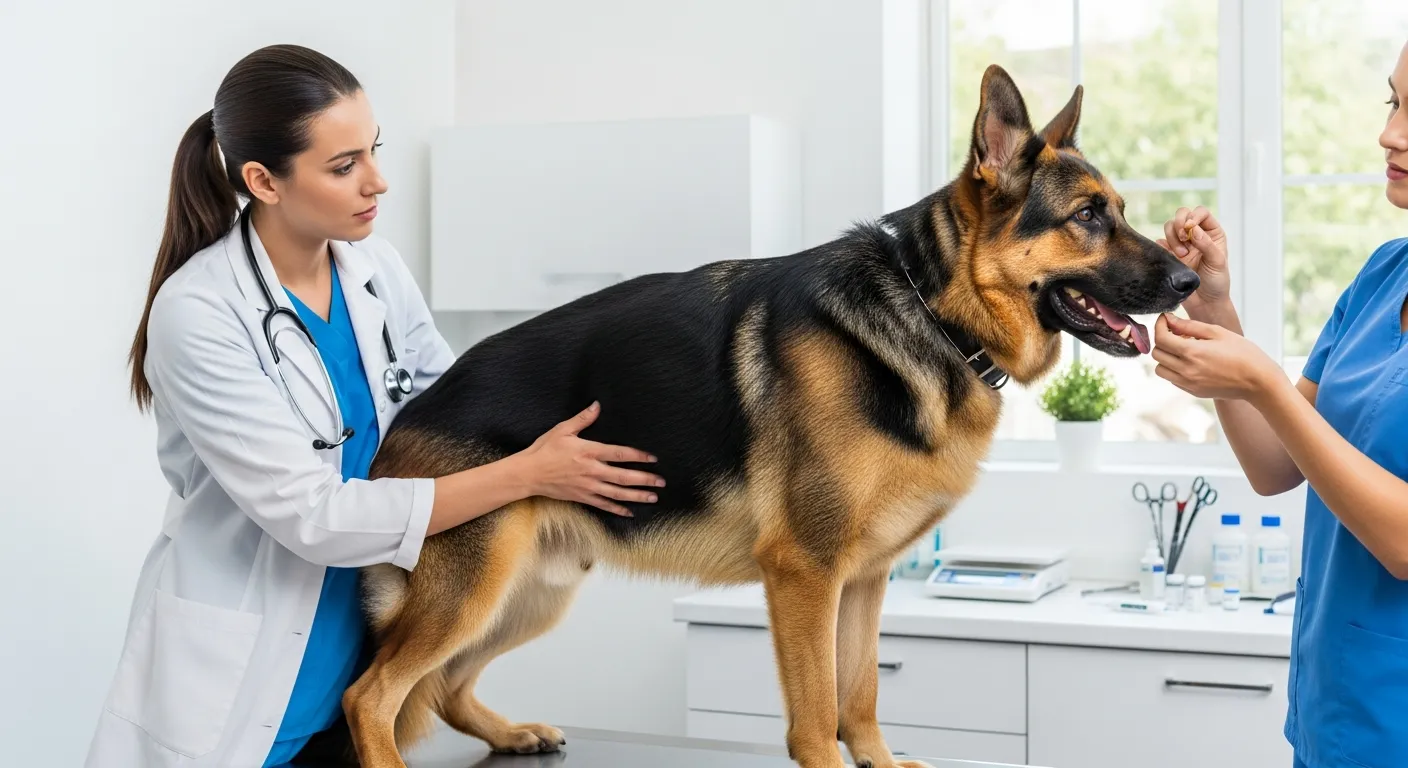
I also assess body condition and muscle mass. Herding breeds should be lean — I want to feel ribs easily under a thin fat covering. An overweight Border Collie with early hip changes is going to deteriorate faster than a lean one. Weight management isn’t glamorous advice, but it’s among the most impactful things you can do for a herding dog’s joints.
Skin and Coat
A full skin check means parting the coat systematically and looking at the actual skin surface. In a double-coated German Shepherd, this takes time. Owners sometimes seem impatient about this part, but I’ve found early mast cell tumours, melanomas, and soft tissue sarcomas during routine skin checks that the owner had no idea were there.
Beyond masses, I’m looking for signs of allergic disease, parasites, areas of hair loss, and skin quality. The condition of the coat is a reasonable proxy for overall health — a dull, brittle coat in a herding breed that should have a glossy one often points to nutritional deficiency, endocrine disease, or chronic illness.
Lymph Nodes
I palpate the submandibular, prescapular, axillary, inguinal, and popliteal lymph nodes. Lymphoma is common in dogs generally, and any unexplained lymph node enlargement needs prompt investigation.
This takes about thirty seconds and is one of the most frequently skipped parts of the physical exam. It shouldn’t be.
The Blood Work Discussion
Here’s where I sometimes disagree with colleagues. Some vets recommend annual blood work for every dog from age one. Others reserve it for seniors or dogs with symptoms. My approach sits somewhere in the middle.
For herding breeds under five with no concerns: I’ll run a baseline panel at around age two. This gives us normal values for that individual dog, which becomes invaluable later when we’re trying to decide whether a slightly elevated liver value is genuinely abnormal or just what’s normal for that dog.
For herding breeds five and over: annual blood work. Full biochemistry, complete blood count, urinalysis. I want to track trends over time. A creatinine of 140 isn’t alarming in isolation, but if it was 90 last year and 115 the year before, that trend tells me the kidneys are heading in the wrong direction well before the dog shows any clinical signs.
Thyroid testing is worth including for herding breeds, particularly German Shepherds and Australian Shepherds. Hypothyroidism is common, develops gradually, and mimics ageing — lethargy, weight gain, coat changes. It’s also very treatable once diagnosed.
What Owners Should Bring to the Appointment
The best wellness exams are collaborative. Come prepared.
Bring a list of concerns, however minor. That thing your dog did once three months ago that seemed odd? Mention it. Context I wouldn’t otherwise have can change what I look for.
Know what you’re feeding. Brand, amount, frequency. If you’ve changed diets recently, tell me why and what happened.
Be honest about exercise. How much, what type, any changes. A Border Collie that’s suddenly reluctant to jump into the car might have a back problem, or it might just have been asked to jump into a different car with a higher boot lip. The context matters.
Mention behavioural changes. Increased drinking, changed sleep patterns, anxiety that wasn’t there before, reluctance to do things the dog previously enjoyed. These are often the earliest signs of medical conditions, particularly in stoic breeds that won’t show pain until it’s significant.
Bring your vaccination and health records. Especially if you’ve changed vets. I need to know what’s been done and when.
The Breeder Connection
Something I feel strongly about: breeders should be asking their puppy buyers about wellness exam findings. Not intrusively, but genuinely.
A breeder who knows that three dogs from a particular pairing developed heart murmurs by age five has information that should influence future breeding decisions. A breeder tracking early-onset allergies across their lines can make choices that improve the health of the next generation. This is how responsible breed improvement actually works — not through show ribbons alone, but through systematic health data collection.
The best breeders I work with — and I’ve been fortunate to know several across different approaches to ethical breeding — actively request wellness exam summaries from their puppy families. They compile the data. They use it. They adjust their programme when patterns emerge. That level of commitment separates breeders who genuinely care about breed health from those who are simply producing puppies.
The Cost Objection
I hear it regularly: “I can’t afford a full wellness exam every year.” I understand. Veterinary care isn’t cheap, and the cost-of-living pressures are real.
But consider this: the wellness exam that catches early kidney disease costs around seventy to a hundred pounds including blood work. Managing end-stage kidney disease costs thousands, involves significantly more suffering for the dog, and often ends badly regardless.
The exam that identifies a grade two heart murmur early allows us to start medication that slows disease progression. The exam that misses it because it wasn’t done means the first sign of heart disease might be collapse or fluid in the lungs.
Preventive medicine is always cheaper than crisis medicine. Always. And for herding breeds with their specific predispositions, the return on investment from annual wellness screening is substantial.
Age-Specific Focus Areas
The wellness exam shouldn’t be identical every year. What I emphasise changes as the dog ages.
Puppies to two years: Growth assessment, orthopaedic screening, behavioural development, parasite management, appropriate vaccination protocols. I’m also establishing baseline values and getting to know what’s normal for this individual.
Two to five years: Peak performance years. Focus on maintaining condition, monitoring for early signs of allergic disease (which typically first appears between one and three years), dental health, and the real cost of health clearances for breeding stock.
Five to eight years: The transition zone. Annual blood work becomes essential. I’m watching for early signs of endocrine disease, cardiac changes, and the first whispers of degenerative conditions. Weight management becomes increasingly important as metabolism changes.
Eight plus: Senior care mode. More comprehensive blood panels, possibly including cardiac biomarkers. Six-monthly exams rather than annual for breeds with shorter lifespans. Cognitive assessment — canine cognitive dysfunction is more common than we used to think, and early intervention helps. Pain assessment becomes a core part of every visit because these dogs won’t tell you they hurt.
Making the Most of Fifteen Minutes
Realistically, your annual wellness appointment is probably fifteen to twenty minutes. That’s not long. Here’s how to make it count:
Don’t save your list of concerns for the end. Lead with them. If you’re worried about your dog’s back legs, say so when I walk in. That changes how I allocate my time during the exam.
Don’t let the vaccination discussion dominate. The jab takes thirty seconds. The exam should take the other fourteen and a half minutes.
Ask questions. If I find something and say “let’s keep an eye on that,” ask me what specifically I found, what I think it might be, and what would make me more concerned. You’re the one who’ll be watching the dog for the next twelve months, so you need to know what to look for.
And if you feel the exam was too quick — if you walked in and out in five minutes with nothing more than a stethoscope on the chest and a needle in the scruff — speak up. Or find a vet who takes the annual wellness exam as seriously as it deserves.
The Bottom Line
Your herding dog’s annual wellness exam is not a formality. It’s not a bureaucratic requirement attached to a vaccination. It’s a systematic, head-to-tail assessment by someone trained to find things you can’t see, feel things you can’t feel, and identify patterns you wouldn’t recognise.
For breeds that hide pain, mask illness, and develop conditions gradually over years rather than days, that annual check is often the difference between early intervention and late discovery.
Book the appointment. Bring your questions. Give your vet the time to do it properly. Your dog will thank you — not with words, obviously, because they’re dogs, but with extra years of quality life. Which is rather the point.