Every veterinarian has bloat stories. The dog that presented at ten pm with an abdomen like a drum, that went straight to surgery, that — if everything went perfectly — had a fifty-fifty chance. The owners who nearly didn’t come in because their dog “seemed a bit uncomfortable” after dinner. The ones who waited to see how the night went.
Gastric dilatation-volvulus, which is what most people mean when they say “bloat,” is one of the genuine veterinary emergencies. Not “better get it checked soon” emergency. “Drive now, not tomorrow” emergency.
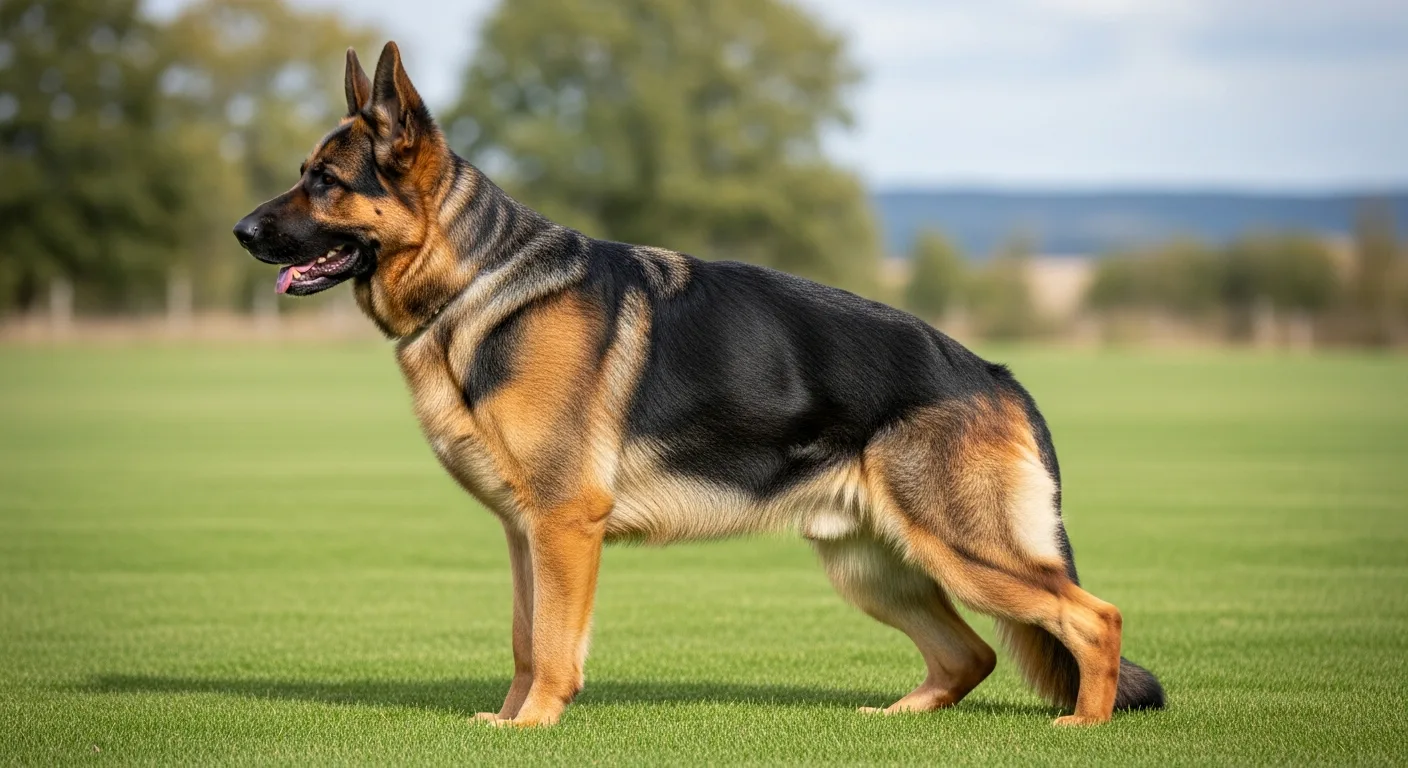
German Shepherds are among the highest-risk breeds. If you have a large herding breed, understanding this condition is not optional.
What Actually Happens
The stomach is normally mobile within the abdomen, held in position by ligaments but able to move. Gastric dilatation begins when gas accumulates in the stomach faster than it can escape — either through belching upward or passage into the small intestine.
In simple dilatation, the stomach stretches with gas but stays in its normal position. This is uncomfortable and can become serious, but it’s not the most dangerous form of the condition.
In volvulus, the distended stomach rotates on its long axis. The rotation twists the exit routes — both the connection to the oesophagus and the pyloric connection to the small intestine. Gas is completely trapped. The stomach continues to distend with fermentation gas.
The consequences cascade rapidly. The distended stomach compresses major blood vessels, reducing blood return to the heart. Tissue in the stomach wall begins to die from loss of blood supply. The spleen, often twisted with the stomach, also loses blood supply. Cardiovascular shock develops. Toxins from dying tissue enter the bloodstream.
Without surgical treatment, GDV is fatal. Even with surgery, mortality rates are 15–30% depending on the severity of compromise at presentation, how long before surgery, and whether the stomach wall has developed necrosis. Dogs that presented too late, or in which necrosis is extensive, have far worse outcomes.
The window between first symptoms and the point of no return is measured in hours. Sometimes less.
Who Is at Risk
Risk factors for GDV are reasonably well-established from epidemiological studies, and German Shepherds feature prominently in the high-risk category.
Breed and body conformation. Large and giant breeds with deep, narrow chests have the highest risk. The deep-chested conformation means the stomach has more room to rotate. German Shepherds sit near the top of breed-specific risk lists across multiple studies. Great Danes have the highest raw risk of any breed, but German Shepherds are common enough that they account for substantial absolute numbers of cases.
Age. Risk increases with age. The peak incidence is in middle-aged to older dogs. A seven-year-old German Shepherd is at higher risk than a two-year-old.
Size within breed. Larger individuals within a breed appear to be at higher risk than smaller ones.
Feeding habits. This is where the management discussion matters. Dogs that eat one large meal per day have higher risk than those eating the same quantity in multiple smaller meals. Dogs that eat very quickly have higher risk. Dogs that exercise vigorously immediately before or after eating have higher risk.
Family history. Dogs with a first-degree relative that has had GDV are significantly more likely to develop it themselves. If your German Shepherd’s parents or siblings have had GDV, this is not just interesting information — it’s a clinically relevant risk factor.
Temperament. Happy, relaxed dogs have lower risk than fearful or anxious dogs in some studies. This aligns with what we understand about the gut-brain connection. A dog with chronic stress and anxiety is physiologically different in its gut function from a calm, settled dog, and these differences may contribute to gas accumulation.
Recognising GDV
The challenge with GDV recognition is that early signs can seem mild. A dog that ate dinner and is now pacing restlessly, seems uncomfortable, and won’t settle may not look like an emergency to an owner who hasn’t been told what to watch for.
Classic signs:
- Distended abdomen, particularly the left side behind the rib cage. Tap it with a finger: if it sounds like a drum, call the vet.
- Unproductive retching — attempting to vomit without producing anything, or producing only small amounts of froth
- Restlessness, pacing, inability to settle
- Drooling more than usual
- Apparent discomfort: looking at the flank, getting up and lying down repeatedly
- Rapid shallow breathing
- As the condition progresses: weakness, collapse, pale gums, rapid heart rate
Not all dogs present dramatically. Some appear relatively comfortable early on. The abdomen may not look obviously distended to an untrained observer before the condition is already serious.
The rule I give to owners of high-risk breeds: if your large herding breed is behaving unusually after eating, or showing any of the signs above, do not adopt a wait-and-see approach. Ring your vet. If it’s out of hours, ring the emergency clinic. The consultation fee for a false alarm is far less than the cost — in every sense — of a delayed presentation.
Treatment: What Happens at the Clinic
For suspected GDV, stabilisation and rapid diagnosis are simultaneous rather than sequential. A dog that comes in cardiovascularly compromised gets intravenous fluid resuscitation while we’re confirming the diagnosis with radiographs.
The radiograph is usually conclusive. The characteristic appearance of the gas-distended stomach, rotated out of normal position, is recognisable with experience.
If the dog is stable enough, gastric decompression before surgery helps reduce the cardiovascular compromise. This usually involves passing a stomach tube, though sometimes a large-bore needle is used to deflate the stomach directly if tubing isn’t possible due to the rotation.
Surgery involves returning the stomach to its normal position — derotation — and then permanently tacking it to the abdominal wall to prevent recurrence. This procedure, gastropexy, is the only lasting prevention against future volvulus.
During surgery, we assess the stomach wall and spleen for viability. Necrotic stomach tissue requires removal; if the damage is too extensive, the prognosis is poor regardless of other factors. The spleen is removed if its blood supply is compromised.
Post-operative monitoring is intensive. Cardiac arrhythmias are common in the 12–24 hours after GDV surgery, caused by reperfusion injury and electrolyte disturbances. Many hospitals admit these patients to intensive monitoring even when the surgery went well.
Prophylactic Gastropexy: The Most Important Prevention Decision
Here’s the thing that many German Shepherd owners don’t know, or know about abstractly but haven’t seriously considered: gastropexy can be performed as a preventive procedure, before any GDV has occurred.
Prophylactic gastropexy, done electively, is a much smaller surgery than the emergency version. It can be performed laparoscopically in a minimally invasive way. Recovery is fast. And it virtually eliminates the risk of the stomach rotating, which is the life-threatening part of GDV.
Dilatation (gas accumulation) can still occur after gastropexy and does require veterinary attention. But the volvulus — the rotation that causes vascular compromise and rapid deterioration — essentially can’t happen when the stomach is tacked in place.
The evidence for prophylactic gastropexy in high-risk breeds is compelling. A cost-benefit analysis in German Shepherds — accounting for surgery costs, mortality risk, and quality-adjusted life years — has consistently supported elective gastropexy as the economically rational choice for high-risk individuals, even before any episode has occurred.
My practice: I discuss prophylactic gastropexy with every German Shepherd owner whose dog is over three years old, and with younger dogs if there’s a family history of GDV. Most practices will perform it at the time of neutering to reduce the number of anaesthetics, though it can be done as a standalone procedure.
If you have a German Shepherd that hasn’t had this conversation with your vet, have it. The risk of GDV in this breed is not hypothetical. It’s a documented statistical reality.
What You Can Do Without Surgery
For owners who aren’t proceeding with prophylactic gastropexy, or while you’re having that conversation, these management steps reduce — but do not eliminate — the risk:
Multiple smaller meals. Feed two or three times per day rather than one large meal. The same daily caloric content distributed across meals reduces gastric volume and fermentation pressure at any one time.
Slow feeding. For dogs that eat quickly, slow feeder bowls or puzzle feeders reduce air ingestion and the rate of distension. There’s also some evidence that eating position (raised versus floor level) influences risk, though this evidence is mixed and I wouldn’t consider it a primary intervention.
Exercise timing. Avoid vigorous exercise for at least an hour before and after eating. This is an area where working dog management sometimes conflicts with this advice — a sheep-working dog being asked to leave the field an hour before its lunchtime meal is a logistical challenge. But if your dog’s risk profile is high, this is worth the logistical inconvenience.
Stress management. For anxious dogs with high GDV risk, managing underlying anxiety may have a modest contribution to reducing risk. As noted above, anxious temperament is associated with higher GDV rates. This is one more reason to take the anxiety and stress management in herding breeds seriously as a health issue, not just a behavioural one.
Know the signs and have a plan. Decide now which emergency vet you would go to if your dog developed signs at 2am. Have the number saved. Know the route. The owner who has made this decision in advance responds faster than the owner who is googling emergency vets while their dog deteriorates.
The German Shepherd Specifically
I’ve generalised somewhat to large herding breeds throughout this piece, but German Shepherds deserve specific emphasis. They are among the highest-risk breeds. The breed’s conformation — deep-chested, often somewhat anxious temperament, common in working contexts where feeding and exercise schedules may be irregular — stacks several risk factors together.
If you have a German Shepherd, the GDV conversation is not optional reading. The management steps above are sensible. The prophylactic gastropexy conversation is something to have seriously and soon.
In twenty-five years of veterinary practice, the GDV presentations I remember most vividly are not the ones that ended badly. They’re the owners who walked in knowing what they were looking at, who drove fast, who gave their dogs a fighting chance because they knew what to watch for. Information saves lives.
This is the information. Use it.